Lawn and garden care that doesn’t cost the Earth
We’re all busy running our little Johnnys and Sallys off to dance, soccer, hockey, you name it. In between grueling work schedules and activities, we don’t always have the time we need to look after our lawns and gardens. But instead of reaching for a quick fix, (Yellow Pages under Lawn Emergency! Help!), combine your stretch and workout time with quality family time and catching some Vitamin D, by using easy and, ultimately, beneficial lawn and garden care.
Just memorize these two acronyms and you’ve got it made:
RYLWNPSAT and MHLYCTDAOSBATP.
It’s that simple!
A no-brainer. Let the pesticide bylaws come – it won’t matter. You are on the cutting edge!
So relax, pour yourself a cool drink and take a break until June. That’s right – no fertilizing, no herbicides, insecticides, kill-icides, no weed ‘n feed, no nothin’! If you fertilize now, you’re wasting your money and just feed‘n the weeds.
But if you want to fool your neighbours and look as busy as they are this time of year – causing all that racket and pollution with their gas mowers and leaf blowers – head outside and have a stroll around your yard. (Still have that cool drink in your hand? Take a sip!) Look for any places your grass isn’t growing well – under trees, shaded areas or hot, dry areas.
This is where the first acronym comes in: Replace Your Lawn With Native Plants, Shrubs and Trees.
This isn’t England, where the conditions are ideal for growing lush, green lawns. This is Canada, with hard cold winters and hot dry summers. There are a huge variety of native plants, shrubs and trees better suited than grass for most conditions. Your local nursery can help you with this. You don’t even have to dig up the grass. Outline your area with the garden hose, lay down about ten layers of newspaper, dump some soil and homemade compost on top and plant. Make sure you mulch around the plants, while they’re getting established, to keep in moisture and prevent weed growth. Think of all that lawn you won’t have to mow anymore! (Celebrate with another sip of that cool drink!)
But speaking of mowing (remember the other acronym?), take a deep breath and repeat after me:
Mow High Leave Your Clippings Top Dress And Over Seed Bare And Thin Patches
That’s the remedy for every lawn emergency and all you have to do to your lawn – ever! If you’ve been using pesticides, you may want to wait until fall and then aerate before overseeding and topdressing. If you really feel you need to look useful, you may want to remove any plants you don’t want in your lawn. Personally, I only remove thistles before I accidentally find them with my bare feet. But you could pay your kids to use any one of the many, really cool handtools, suitable to any size or shape, sitting or standing, available at your local hardware store or nursery. Or declare your yard to be a wildlife sanctuary and leave your dandelions to feed your local, wild rabbit population – they’ll make short work of them – flowers, stems, leaves and all – and leave some free fertilizer behind. You also may want to add white dutch clover to your grass seed mix for the added benefit of fixing nitrogen and eliminating the need for fertilizers.
And while you’re at it – find a nice sunny spot to grow something you can eat. Check out www.growarow.org and it will tell you how you can share your extra produce with those in need. Nothing better than homegrown, uh, tomatoes – then sharing them! If you’d rather share your yard’s bounty with the birds and the beasties (remember those bunnies?) and meet the criteria, you can even get a nice certificate designating your yard as a Backyard Habitat from the Canadian Wildlife Federation
http://www.wildaboutgardening.org/en/gab/section5_certify/index.htm
Now sit back and enjoy another cool drink. Have a look at the contents of your glass. Aren’t you glad you didn’t use any pesticides and synthetic fertilizers or other nasty chemicals that could end up in it?
Back to the top
2. What grows on concrete?
Ever since humans evolved from foragers to farmers, we have been trying to manipulate our environment to grow plants we want, and not what nature put there. We need to grow food to eat, but our agricultural methods have led to devastating soil erosion and subsequent sedimentation in our water systems; deforestation; water and air pollution from fertilizer, pesticides and machinery; loss of species diversity and habitat; extensive pest resistance to chemical control products; desertification, consumption of fossil fuels; and increased salination and the spread of disease through irrigation. http://www.eap.mcgill.ca/DIAE_1.htm
Although there are far less destructive methods of food production, at least the land is being used for something that can be eaten. The same cannot be said of most suburban yards.
Grass still seems to be the groundcover of choice, clipped to within a centimeter of its life, and kept alive on a chemotherapeutic life support system of pesticides, synthetic fertilizers and treated municipal water.
But think how wonderful it would be to live in a neighbourhood teeming with life – towering trees cooling the streets on a hot summer day, the full-sensory delight of yards filled with the buzzing of pollinating insects, a cacophony of birdsong, and the intoxicating aroma and colour explosion of thousands of blossoms. It’s time to rethink the “perfect golfgreen” lawn and replace some, or all of it, with different groundcovers. We may live in concrete jungles, but our jungles are still part of a larger ecosystem that needs our help. So even if your gardening space is limited to one pot on your balcony, you can still become an advocate for rooftop gardens, community gardens or green roofs that will help reduce air pollution, filter rain water, slow down storm run-off and cool our cities.
If you’re a ground-dweller, you can replace much of your lawn with native plants, trees and shrubs that will provide food for wildlife (insects, birds, etc.) and your family. Native plants have evolved over time to adapt to their environment and require no added inputs such as fertilizer, pesticides or even water once the plant is established, if it’s the right plant in the right place.
One of the challenges, besides the ever-unpredictable weather (don’t get me started on climate change!), is to match the plant to the environment. Is your soil sandy, clay or loam; is the location sunny and dry, wet and shady, dry and shady? What plants grow best in each of these conditions?
There are an enormous number of resources, on-line and in your library or bookstore, and from your local nursery, to help you make the right plant choices. Native plants are usually identified as such in nurseries, which is a great help. If you want to do some research beforehand, Lorraine Johnson’s books, in particular, are geared specifically to Canadian gardeners and provide descriptions of the proper growing conditions, and mature size of native plants to meet your gardening needs – and has great photos!
Sweet Grass Gardens in Hagersville Ontario is also another excellent resource to help you pick the right native plants for the right conditions. http://earthcaretaker.com/nativeplants/soiltypes.html
Be prepared for some disappointments though. Even if you’ve done everything right, gardening is always trial and error. Some plants will just not do well in your garden. If anyone took a good look into my gardening past, I’d be imprisoned for life for all the “bodies” buried in my backyard. But they’d never find them beneath all the survivors – the lush butterfly bushes, wild roses, sweet woodruff, cup and saucers, columbines, lobelias, dogwoods and serviceberries that are feasting on the remains!
Back to the top
3. To amend or not to amend: the Zen of composting and using what you have
If our consumer society had its way, we’d be buying annuals every year, hauling in yards and yards of topsoil, fertilizing four times a year and spraying pesticides to kill every bug and weed that had the misfortune to find its way into our yard. The golf course lawn, the flower border, the strategically placed 1 point 2 trees …
But what price are we paying for this photo-op? The impact of our lawn and gardening choices don’t stop at the edge of our properties and we must consciously decide whether to be beneficial, benign or harmful to our world.
I admit I wrote “Zen and composting” with my tongue firmly in my cheek, but the more I thought about it, the more I realized that the path to gardening (and environmental) enlightenment leads directly from that pile of decomposing garden and kitchen scraps in your yard.
Think about it. By using compost made from your kitchen and garden scraps you are:
Ø eliminating the need for synthetic fertilizers that are produced by using non-renewable fossil fuels
Ø preventing water pollution, algae overgrowth and fish kills caused by nitrogen overload from synthetic fertilizers
Ø reducing the amount of waste going into landfills
Ø increasing the organic matter and moisture-holding capacity in your soil and creating more topsoil
Ø improving air quality by keeping and using your autumn leaves instead of having them trucked away by a non-renewable fossil-fuel-using truck
No synthetic chemical from the lab can match compost in its ability to make your plants healthier and less susceptible to disease and pests. Compost has been scientifically proven to reduce damping off and root rot disease, create healthier root systems, conserve moisture, destroy pathogens, and encourage the growth of fungi and other organisms that control harmful parasitic nematodes.
And all you have to do is keep piling on the organic material and let the house millipedes, sow bugs, snails and slugs, fungi, bacteria, and actinomycetes, mites and springtails, earthworms, nematodes, red worms and potworms, flies, earwigs, pseudoscorpions, spiders, ants and beetles do their job to create black gold.
Ye gotta love those bugs!
Although I’m sure all entomophobics and insecticide manufacturers would disagree, the vast majority of bugs and microbes are beneficial. Without ‘em, we’d all be dead. A report out of Cornell University and the Xerces Society http://www.xerces.org/pubs_merch/Econ_Value_of_Insects.htm, actually put a dollar figure to the services insects provide – $57 billion worth of pollinating, pest control, clean up and food source. Think about how much garbage and organic waste we’d be sitting under if we didn’t have microbes and insects to break down autumn leaves, fallen branches, grass clippings and kitchen scraps. Think about how hungry you would be without insects to pollinate our crops and flowers and produce honey.
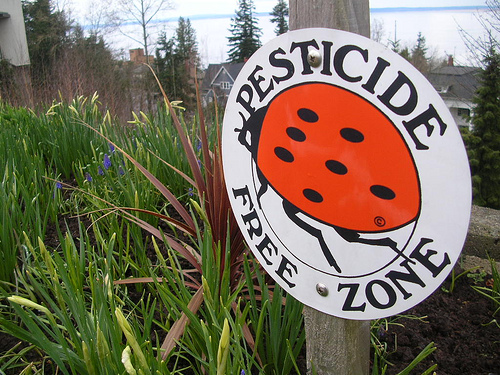
We’re faced with that right now. Cockroaches may survive nuclear fallout, but bee populations are being decimated around the world by human activities. Some scientists are referring to the disappearance of bees as today’s “canaries in the coalmine”. They hypothesize that Colony Collapse Disorder, as it’s called, is due to the loss of wildflowers, climate change and extreme weather, Bt corn, viral mites and pesticides. In the U.S., some areas are reporting a 90% drop in bee populations. If we lose the bees, it’s the end of agriculture and the end of us. There is no need to wait, and indeed there is an urgency, to designate our yards as pesticide-free zones, full of wildflowers, to increase the hospitable habitat for these vitally important critters.
I offer this mantra, which may be new to some of you, “I am part of an ecosystem. What I do on my property has an impact on my larger neighbourhood ecosystem. I will strive to work with Mother Nature, instead of fighting with her and trying to control her.”
But this is just the beginning of your path to enlightenment. The next steps are to walk or bike more, grow your own food organically or buy local and organic, refuse excess packaging, use energy efficient appliances… Check out the Suzuki Foundation for tips on everyday environmentalism at www.davidsuzuki.org and make your commitment to our planet.
Back to the top
4. The Water Cycle and some things you should know, but might not want to think about, when you turn on the tap
During my misspent youth, I first heard the joke that you don’t buy beer; you just rent it. That’s pretty well what happens with all the water on the planet too. Like energy, water is neither created nor destroyed; it just keeps changing form.
Despite the fact that seventy percent of Earth’s surface is covered with water, it is unbelievable that only .3 percent is usable by humans. The remaining 99.7 percent of the water is either in the oceans and seas (too salty), ice (too cold) or the atmosphere (too hard to catch). Water, water everywhere, and barely a drop on the planet to drink.
But if you are one of the 40 million people living in the Great Lakes Watershed, consider yourself lucky. The Great Lakes hold one-fifth of the world’s fresh water supply.
Fresh. That’s funny.
Years ago, reports started coming in that the Great Lakes were exhaling pollutants. Exhaling pollutants. Don’t they want them either? We used to think the lakes were so big they had a limitless capacity to absorb our waste products. You know the old maxim – dilution is the solution to pollution. Turns out bio-magnification (toxins accumulating up the food chain) and synergy (chemicals combining in new ways resulting in greater effect) would be more accurate. What are the Great Lakes telling us?
One theory is that, depending on which has the greatest concentrations of contaminants, the air or the water, the other will spew. With all the bad air we’ve had for decades around the Great Lakes, the water pollution must be extraordinary!
Nowadays, we are getting smarter and know that when we throw away garbage and flush you-know-what down the toilet, it doesn’t just go away. Some of it breaks down; some of it mixes with other stuff and creates some new stuff that’s often worse than the first stuff. It’s like the undead in all those old horror movies. The thing that wouldn’t die or the blob from the black lagoon – you get the picture.
Our municipal water treatment plants use filtration, screening, coagulation, sedimentation, flocculation, disinfection with chlorine and/or chloramines and even ultraviolet light and ozone to clean it up. Still unsure of the safety, many people add their own reverse osmosis or filter treatments at the end of the pipe in their homes.
Without a doubt, water sanitation has contributed immeasurably to our health and longevity. But as we’re all too well aware, accidents happen. Unexpected and/or invisible pathogens and chemicals find their way into our water.
If it’s not PCB’s, dioxins, furans, mercury, endocrine disruptors, cleaning products, prescription drugs, personal care products and human and animal waste, it’s pesticides and synthetic fertilizer run-off from agriculture and lawns.
John Struger, an Environment Canada scientist, has shown repeatedly that the pesticides and synthetic fertilizers we use on our lawns are making their way into our water system through our stormwater systems, holding ponds, streams and eventually lakes, some at levels lethal to some aquatic life.
The National Centre for Atmospheric Research www.ucar.edu/org/ has some interesting things to say about nitrogen (the N in the NPK on a synthetic fertilizer bag). Human interference in the nitrogen cycle, through the use of fertilizers for example, can change the soil to favour weeds over native plants. Nitrogen run-off into water bodies causes algae overgrowth that depletes oxygen that kills fish and ruins water quality (called eutrophication).
Many of the contaminants in our water are out of our personal control, but we DO have control and, therefore, the responsibility to properly dispose of toxic substances such as paints and solvents and to not use or hire companies that use harmful fertilizers and pesticides on our properties.
It’s just a lawn. Why take the risk?
Back to the top
5. What doctors say about pesticides and why you should be concerned about using them
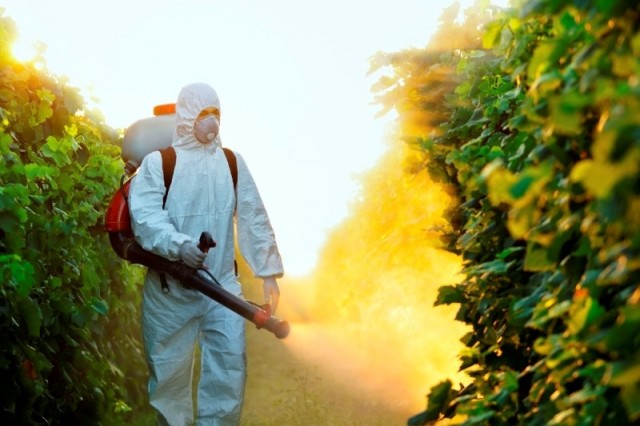
A pesticide is a substance released into our environment to selectively kill organisms we consider undesirable. Herbicides, insecticides, fungicides and combination products such as “weed ‘n feed” are all pesticides. About seventy percent of pesticides are used in agriculture, with the remaining thirty percent used for forest management, lawns and gardens, golf course maintenance, pet care, industrial site care, as repellents, and for indoor pest management such as in washrooms, closets and building structures.
While an argument could be made for the selective use of pesticides to deal with outbreaks, agricultural use or spot application for infestations, this is distinct from the undifferentiated, widespread use we are witnessing today. The benefits of cosmetic pesticide use are not justified because of the risk to public health.
In 2004, The College of Family Physicians of Ontario released a comprehensive report on pesticide exposure and health risk, concluding that all commonly used pesticides show a positive association with adverse health effects.
The study found:
Ø an increased risk of lung cancer from exposure to phenoxy herbicides (e.g. 2,4-D) and carbamates;
Ø an increased risk of kidney cancer in offspring of occupationally exposed men;
Ø 2,4-D and Dicamba were associated with increased time to pregnancy;
Ø pyrethrins were associated with delayed, chronic neurological effects (Parkinson’s disease), chromosome aberrations, rashes in licensed pet pesticide applicators, and fetal intrauterine growth retardation (IUGR);
Ø fungicide exposure had a positive association with dermatitis;
Ø glyphosate and glufosinate were associated with congenital malformations;
Ø Parkinson ’s disease and possibly amyotrophic lateral sclerosis (ALS) and Alzheimer ’s disease in men were linked to long-term pesticide exposure;
Ø an increased risk of childhood acute lymphocytic leukemia if pesticides were used in the home and garden during pregnancy;
Ø adverse neurological effects in children;
Ø a decline in non-Hodgkin’s lymphoma in countries where the herbicide 2,4-D had been banned for over ten years. The authors concluded that 5% of NHL is attributable to pesticide exposure.
Manifestations of acute exposure to insecticides may include neurological, gastrointestinal, dermatological and respiratory symptoms, and even heart block and death, due to acetylcholine blockade. Herbicides generally have little acute toxicity, except for paraquat – a severe respiratory toxin. Although chronic effects are more difficult to demonstrate, increased use of pesticides appears to put farmers and their families, gardeners and golf course superintendents at higher health risk.
Some sub-groups, such as children (along with fetuses, the elderly and pets), may have a biological vulnerability and be at higher risk. Relative to their weight, children eat more, drink more, breathe more, and have a greater surface area and a more permeable blood brain barrier than adults do. In addition, they may have greater exposure due to diets more concentrated in specific foods and more hand to mouth behaviour, including eating soil. They spend hours in areas of highest concentrations of pesticides – on the ground (floor, grass), often with little clothing. Finally, children (and pets) cannot read warning labels or instructions.
Despite this evidence, the pesticide industry continues to claim that pesticides are “safe” when used as directed, because they are studied and approved by governmental agencies. The controversy has precipitated a re-evaluation of the federal Pest Control Products Act. As of this writing, not all the changes have been implemented, but many products used on lawns and gardens have now been removed or had new restrictions applied to them.
Public pressure from individuals and groups belonging to organizations such as Pesticide Free Ontario, with strong support from health organizations such as The Canadian Cancer Society, Canadian Association of Physicians for the Environment and the Registered Nurses’ Association of Ontario, has also resulted in almost 130 municipalities across Canada, including Toronto, Montreal and Halifax, and the entire province of Quebec enacting bans.
Regardless of whether your community has restricted pesticides, you can make the choice to protect your health and environment by eliminating the use of pesticides around your home and garden.
Adapted from:
Arya N. Pesticides and human health: Why Public Health officials should support a ban on non-essential residential use (Commentary). Can J Public Health 2005;96(2):89-92.
Dr. Arya is a family physician; Adjunct Professor, University of Waterloo; member of the Ontario College of Family Physicians (OCFP) Environmental Health Committee and of the Canadian Association of Physicians for the Environment (CAPE). He was also a peer reviewer for the study of the Ontario College of Family Physicians and is now on Health Canada’s Pest Management Advisory Council.